

5 min read
You may have already seen it on the shelves, or perhaps read it in a single sitting.
Swan Song: Diana, My Sister, published this September by Charles Spencer, Earl Spencer, arrives thirty years after his sister’s death and carries the weight of everything that was never quite said. It is an intimate account, written by someone who knew Diana not as an icon but as a person ; and its release has reminded the world, once again, of something the British have always known: that their royal family is not simply a constitutional arrangement. It is one of the most compelling stories on earth. For travelers, that story has an address. Several, in fact.
A Myth That Lives in Stone and Ceremony
The British monarchy is the longest-running continuous royal house in the Western world, and what makes it remarkable as a travel experience is precisely that it has never become purely historical. The palaces are still occupied. The ceremonies are still observed. The estates are still tended. Unlike so many of Europe’s royal legacies, preserved in amber, roped off, explained by audio guide, the British Crown remains a living institution, and the places associated with it carry a presence that no museum can replicate.
To walk through these landscapes is to move through centuries of history that somehow remains current. The guards still change. The flags still signal who is in residence. The gardens are still cut to standards set generations ago. Britain has an exceptional gift for making the past feel urgently present, and nowhere is this more true than in its royal geography.
In the Footsteps of Diana and of the Crown
Kensington Palace is perhaps the most emotionally resonant starting point. Diana lived here throughout her marriage and in the years that followed, and it remains today a working royal residence, home to the Prince and Princess of Wales and their children. Its public rooms and gardens are open to visitors, and the sense of layered history is palpable: William III commissioned Christopher Wren to expand it in the seventeenth century; Queen Victoria was born within its walls; Diana chose it as her home in the capital. The Sunken Garden, which blooms each spring with white flowers planted in her memory, has become one of the quiet pilgrimage points of London.
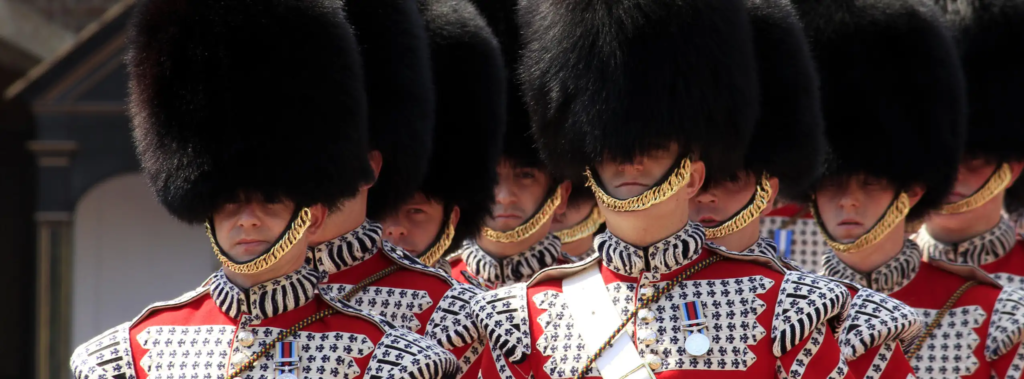
Buckingham Palace anchors the other end of the royal experience: grand, formal, unmistakably symbolic. The Changing of the Guard, one of the most choreographed rituals in the world, takes place on its forecourt with a precision that has been refined over centuries. During August and September, the State Rooms are open to the public: gilded salons, thrones, portraits of monarchs stretching back across the centuries. It is the kind of interior that makes history feel less like a subject and more like a room you are standing in.
Westminster Abbey carries perhaps the greatest density of royal history of any single building in Britain. Every English and British monarch since William the Conqueror has been crowned here, with two exceptions. Diana’s funeral was held here in September 1997, watched by an estimated 2.5 billion people worldwide. The Abbey is a working church, and attending a service here, even an ordinary choral evensong, is an experience that few other buildings in the world can offer.
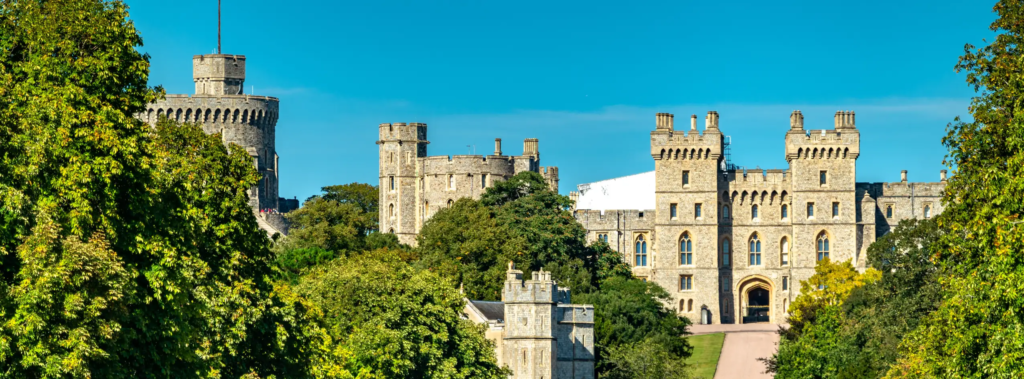
Windsor Castle, forty minutes from London, is the oldest and largest occupied castle in the world, and the weekend residence of the royal family. St George’s Chapel within its walls is the spiritual home of the Order of the Garter, the oldest order of chivalry in existence, and the resting place of ten monarchs. The Long Walk stretching from the castle’s gates through the Great Park is one of the great formal landscapes of England, three miles of avenue, planted with elms and chestnuts, designed to make an approach feel like an event.
Althorp, the Spencer family estate in Northamptonshire, is in a different register entirely. It is not a royal palace but an ancestral home, one that has been in the Spencer family since 1508 — and Diana spent her childhood here. She is buried on a small island in the estate’s ornamental lake, and the grounds are open to visitors each summer. There is something quietly powerful about Althorp: it is where the public story of Diana began, and where she now rests, at a remove from the world that pursued her so relentlessly.
For those drawn further north, Balmoral Castle in the Scottish Highlands has been the royal family’s private summer retreat since Queen Victoria fell in love with the Scottish landscape in the 1840s. It was here that Diana spent some of her most difficult summers as Princess of Wales, and here that the family gathered in the days before her death. The estate is open to visitors during the summer months when the royal family is not in residence, and the surrounding Cairngorms landscape, heather moorland, ancient forest, the River Dee running cold through the valley, offers a vision of Britain utterly different from its southern face.
To Live It, Not Simply See It
The places described above can be visited independently. But the difference between visiting a royal residence and truly inhabiting the world it represents is precisely the difference that Decouvertes DMC UK was built to make.
Our Experience Designers craft itineraries that move beyond the public rooms and the guided tours, into the private dining rooms of London’s most storied institutions, the country house estates that received royal guests for centuries and still receive discerning travelers today, the tailors of Savile Row who have dressed the Crown for generations, the racing at Ascot, the tennis at Wimbledon, the afternoon tea services that have remained unchanged since the Victorian era because nothing has been found to improve them. Britain’s royal story is not one to be observed from behind a rope. It is one to be lived, one carefully chosen experience at a time.
To begin building your clients’ royal journey through the United Kingdom, reach out to our team at reservation-uk@decouvertesdmc.com.
Decouvertes DMC Group. France. United Kingdom. The journey between.