

6 min read
France is often spoken of through its landscapes and its table:
The lavender-swept plateaus of Provence, the vine-terraced slopes of Burgundy, the long slow rivers of the Loire. These are the images that first arrive in the imagination, and they are not wrong.
But to know France only through what the eye can see and what the palate can taste is to miss something essential, something that lives in sound, in gesture, in the charged silence of a darkened theatre just before the curtain rises.
France is a country built by culture. Not culture as monument or curriculum, but as living practice, as daily inheritance, as the accumulated devotion of generations who understood that art was not an adornment to life but one of its highest forms.
For travellers who seek more than beautiful views, this depth is itself a destination. And within it, opera and the lyric arts hold a particular place, older than the Republic, more intimate than a museum, more alive than any monument can ever be.
A Tribute: Louis Erlo and the Men Who Keep Art Alive
This past year, the world of French opera lost one of its most quietly formidable figures. Louis Erlo, who died in 2026 at the age of ninety-seven, spent his life in service to the lyric arts: first as a stage director in Lyon, then as director of the Festival d’Aix-en-Provence from 1982 to 1996, where he transformed a summer celebration into one of Europe’s most daring musical laboratories.
The productions he shepherded into existence have become legend: the world stage premiere of Rameau’s Les Boréades, Jessye Norman as Phèdre in Hippolyte et Aricie, William Christie and Adrian Noble’s The Fairy Queen, Robert Carsen’s A Midsummer Night’s Dream, a nocturnal world of blue and green that would travel the world’s great stages and return to Aix more than twenty years later. These were events that could only have happened in France, in the particular confluence of beauty, ambition and cultural seriousness that this country, at its best, makes possible.
Louis Erlo believed that art required stewards: people who understood both the weight of tradition and the necessity of risk. France has always produced such figures, directors, conductors, curators, who ensure that beauty is not merely preserved behind glass but lived, performed, breathed. It is because of people like him that the conversation of French culture continues, unbroken, from one generation to the next.
Opera as a Way of Life
France has more opera houses per square kilometer than almost any country in the world. Its festivals do not supplement the cultural calendar; they define the summer itself. The season begins in late spring and unfolds through the warm months, when the Mediterranean light stays long and the air holds still enough to carry a voice across an open courtyard.
What makes opera in France distinct is its embeddedness in place. A production at the Théâtre de l’Archevêché in Aix is not merely a performance, it is an evening shaped by the stones of an eighteenth-century archbishop’s palace, by the heat of a Provençal night, by the sense that art and landscape have always been in conversation here. It cannot be replicated in a concert hall. It must be attended.
A Grand Tour of French Lyric Life
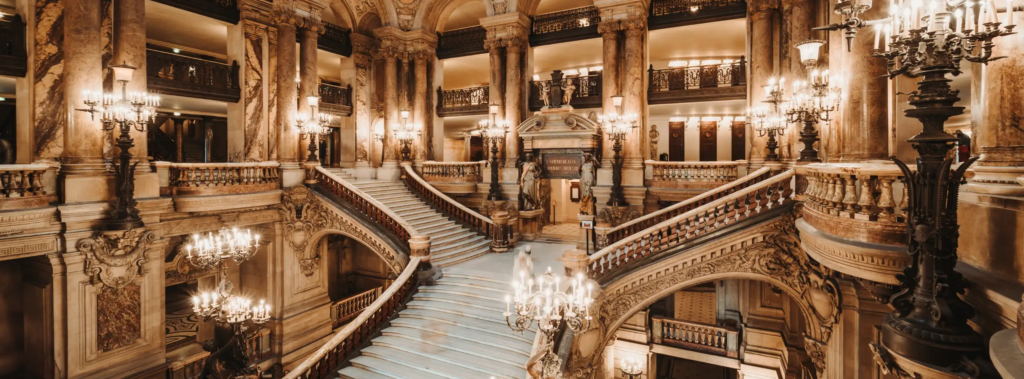
In Paris, the Opéra national de Paris operates across two addresses that embody the full arc of French lyric ambition. The Palais Garnier, inaugurated in 1875, with its grand staircase, its mirrored foyer and its Chagall ceiling, is a monument to the belief that architecture and opera are inseparable expressions of national greatness. The Opéra Bastille, opened in 1989, pursues a different ideal: acoustic perfection, democratic grandeur, a house built not for the aristocracy of appearances but for the sovereignty of sound.
In Aix-en-Provence, the Festival d’Aix has been the heartbeat of French operatic summer since 1948. Held in the Théâtre de l’Archevêché, an open-air courtyard of exceptional intimacy, it consistently attracts the world’s finest artists, not despite its scale but because of it. The distance between performer and audience here is almost unbearably close. It is the kind of theater that changes people.
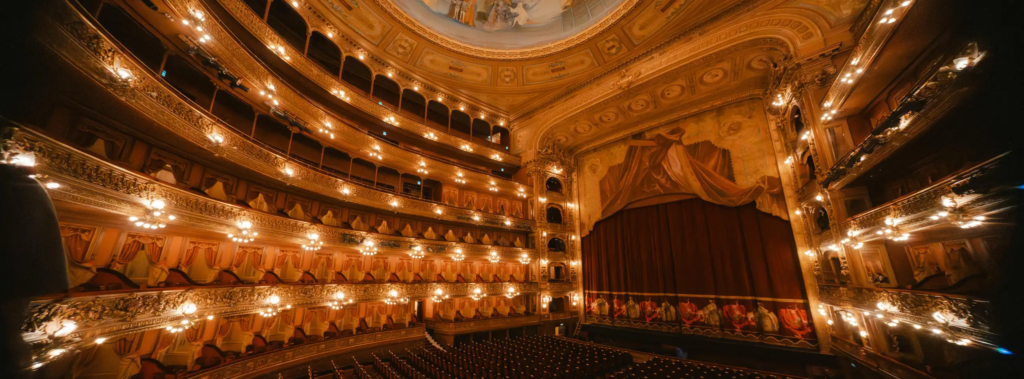
The Chorégies d’Orange stages its productions inside a Roman theater built in the first century CE, where an ancient stone wall provides a natural acoustic shell. The voices that carry through that space do not compete with the architecture; they inhabit it. Further north, the Opéra national du Rhin in Strasbourg draws on the double cultural inheritance of a city that has moved between France and Germany across its history, its repertoire is neither purely French nor Germanic, but something richer than either. In Lyon, the Opéra national occupies a neoclassical building whose interior was transformed in 1993 by Jean Nouvel, a glass barrel roof rising above the original façade, a gesture of dialogue between past and present that perfectly describes the institution’s artistic spirit. And in Bordeaux, the Grand Théâtre, with its twelve Corinthian columns and oval hall of exceptional beauty, offers a lyric life embedded in one of France’s most complete cities: wine country, maritime gateway and cultural capital in equal measure.
What Decouvertes DMC Believes, and What We Offer
At Decouvertes DMC Group, we have always understood that the most extraordinary journeys are built around meaning. Culture is not the backdrop to a luxury trip through France; for many of our travelers, it is the reason for coming. The collector of experiences who has attended Salzburg wants to understand what Aix offers that cannot be found elsewhere. The traveler who has explored the châteaux of the Loire wants to hear, in the great theaters of Lyon or Bordeaux, the music that once filled those rooms.
Our Experience Designers build programs that honor this depth. A week centered on the Festival d’Aix might include a private conversation with a production designer, dinner alongside a sommelier who has spent years building wine lists for the most demanding operagoers, an evening in a private salon where chamber music plays against stone walls that have heard the same harmonies for three hundred years. The performance is the anchor. The days around it are designed with the same care.
What Louis Erlo gave the world was not only a series of exceptional productions. He gave future generations a model of what cultural life could be when it is taken seriously. At Decouvertes DMC, we take it seriously. The art is inseparable from the place. And when you are ready to find both, we are ready to guide you.
Plan A Cultural Journey Through France
The next festival season is already taking shape. Whether your clients are drawn to the intimacy of Aix, the grandeur of Orange, the architectural drama of the Opéra Bastille, or an itinerary that weaves several lyric experiences across the country, our Experience Designers are ready to build something worthy of the art.
To begin the conversation: reservation-france@decouvertesdmc.com
Decouvertes DMC Group. France. United Kingdom. The journey between.